 +44 7520 6444 21
  +44 7520 6444 21
  support@dissertationhelpzone.co.uk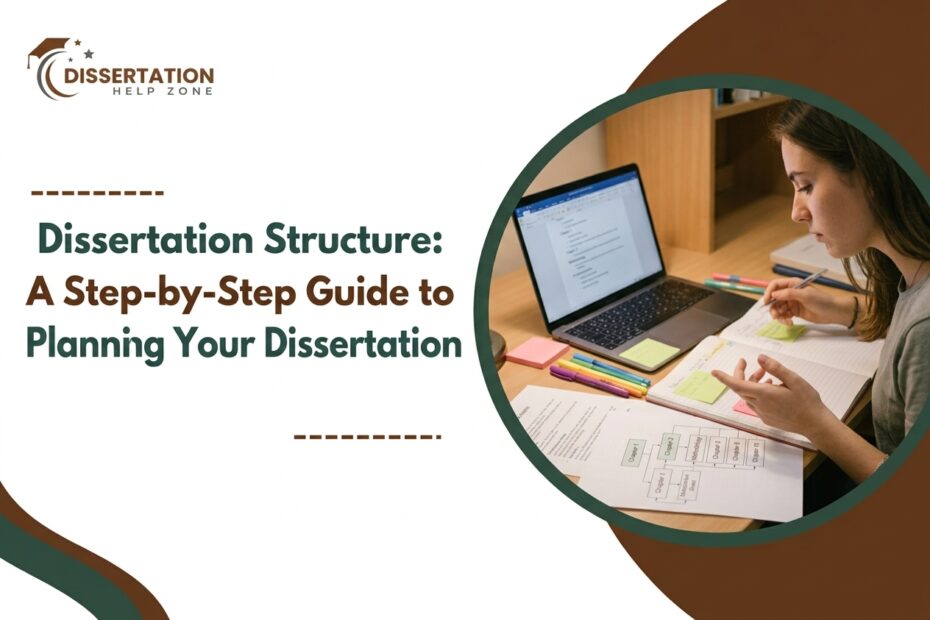
Understanding the correct dissertation structure is one of the first steps towards writing a successful dissertation. A clear structure helps you organise your research, present your arguments logically, and make sure every important section is included.
The requirements for a dissertation at a UK university can differ depending on the institution, degree and subject. Most dissertations, however, follow a similar overall format, starting with an introduction and literature review, followed by methodology, findings, discussion, and conclusion.
If you are unsure how to structure a dissertation, this guide explains the main dissertation chapters, what each section should contain, and how to plan your dissertation format effectively.
What Is a Dissertation Structure?
A dissertation structure is the overall organisation of your dissertation. It determines the order in which you present your research, arguments, evidence, findings, and conclusions.
A typical dissertation includes:
- Title page
- Abstract
- Acknowledgements
- Table of contents
- Introduction
- Literature review
- Methodology
- Results or findings
- Discussion
- Conclusion
- References
- Appendices
Not every dissertation will contain exactly the same sections. For example, some subjects combine the results and discussion chapters, while a literature-based dissertation may use a different chapter structure.
Before starting, check your university’s dissertation guidelines to confirm the required format.
Why Is Dissertation Structure Important?
A well-planned structure makes your dissertation easier to write and easier for your reader to follow.
Your structure should create a logical progression:
Research problem → Existing research → Research methods → Findings → Interpretation → Conclusion
Each chapter should have a specific purpose and contribute to answering your research question.
A clear structure can help you:
- Organise your research effectively.
- Avoid repeating the same information.
- Present your arguments logically.
- Maintain focus on your research question.
- Allocate your word count appropriately.
- Make editing and proofreading easier.
Planning your structure before writing can also prevent the common problem of spending too many words on one chapter and not leaving enough space for your analysis and discussion.
Dissertation Chapters: What Should Each Chapter Include?
The main dissertation chapters usually form the core of your research. While the exact arrangement can vary, the following structure is common across many UK undergraduate and postgraduate dissertations.
- Introduction
The introduction establishes the foundation of your dissertation.
It should introduce your research topic and explain why the subject is important. It should also provide enough context for the reader to understand the research problem.
A typical introduction includes:
- Background to the topic
- Research problem
- Research aim
- Research objectives
- Research questions
- Significance of the study
- Brief overview of methodology
- Dissertation structure
You do not need to provide detailed findings or extensive literature in the introduction. Keep the discussion focused on establishing the purpose and direction of your research.
Example
If your dissertation examines the impact of remote working on employee wellbeing, your introduction might explain the growth of remote working, identify concerns surrounding employee wellbeing, and establish what your research intends to investigate.
- Literature Review
The literature review examines existing academic research related to your topic.
This chapter demonstrates your understanding of the existing academic conversation and identifies important theories, themes, debates, and research gaps.
A strong literature review should:
- Introduce relevant theories and concepts.
- Compare previous studies.
- Evaluate the quality of existing research.
- Identify disagreements and limitations.
- Highlight gaps in the literature.
- Establish the relevance of your own research.
Avoid simply describing one source after another. Instead, organise the literature around themes, concepts, or debates.
The literature review should ultimately explain why your research is necessary.
- Methodology
The methodology explains how you conducted your research.
This chapter should provide a clear explanation and justification of your research choices.
Depending on your project, it may include:
- Research philosophy
- Research approach
- Research design
- Research methods
- Sampling strategy
- Data collection
- Data analysis
- Ethical considerations
- Reliability and validity
- Methodological limitations
For example, if you conducted interviews, explain who participated, how participants were recruited, how the interviews were conducted, and how the resulting data was analysed.
The important point is to explain not only what you did but also why you selected those methods.
- Results or Findings
The results or findings chapter presents what your research discovered.
For quantitative research, this may involve:
- Tables
- Graphs
- Statistical tests
- Numerical results
- Patterns in the data
For qualitative research, it may include:
- Themes
- Categories
- Participant responses
- Patterns identified during analysis
The objective of this chapter is to present the results. Depending on your research design and university requirements, detailed interpretation can be left for the discussion chapter.
Make sure that your results are directly related to your research questions and objectives.
- Discussion
The discussion chapter discusses the importance of your findings.
This is often one of the most important parts of the dissertation, as it shows your ability to interpret research, not just report it.
Your discussion should:
- Interpret your findings.
- Compare them with previous research.
- Explain agreements or differences.
- Relate findings to relevant theories.
- Discuss unexpected results.
- Consider the implications of your findings.
For example, if your findings show that remote working improves employee flexibility but increases feelings of isolation, you could compare these findings with previous studies discussed in your literature review.
The discussion should answer the question: What do these findings mean?
- Conclusion
The conclusion brings your dissertation together.
It should provide a concise answer to your research question and summarise the most important findings.
A conclusion may include:
- Summary of key findings
- Answer to the research question
- Achievement of research objectives
- Research implications
- Limitations
- Recommendations
- Suggestions for future research
Do not introduce completely new arguments or evidence in the conclusion.
A strong conclusion should leave the reader with a clear understanding of what your research has demonstrated.
Dissertation Chapter Structure: How Does It Fit Together?
Understanding the dissertation chapter structure becomes easier when you think of each chapter as answering a different question.
| Chapter | Main Question |
| Introduction | What is the research about and why does it matter? |
| Literature Review | What is already known? |
| Methodology | How was the research conducted? |
| Findings | What did the research discover? |
| Discussion | What do the findings mean? |
| Conclusion | What can be concluded from the research? |
This progression creates a logical argument throughout your dissertation.
For example, the literature review may identify a gap in existing research. The methodology then explains how you investigated that gap. The findings present your evidence, while the discussion interprets it and the conclusion explains what can ultimately be learned from the study.
How to Structure a Dissertation Step by Step
If you are wondering how to structure a dissertation, planning each section before you begin writing can save considerable time.
Step 1: Start With Your Research Question
Your research question should be at the centre of your dissertation.
Every chapter should contribute towards answering it. If a section does not support your research question or objectives, consider whether it is necessary.
Step 2: Create Your Chapter Outline
Write down your main chapters and divide each one into smaller sections.
For example:
Chapter 2: Literature Review
- 2.1 Introduction
- 2.2 Key concept
- 2.3 Theoretical framework
- 2.4 Theme one
- 2.5 Theme two
- 2.6 Research gap
- 2.7 Chapter summary
This gives you a practical roadmap for writing.
Step 3: Allocate Your Word Count
Your dissertation word count should influence how much space you give each chapter.
For a 10,000-word dissertation, a possible allocation might be:
- Introduction: 1,000 words
- Literature review: 2,500 words
- Methodology: 1,500 words
- Findings: 2,000 words
- Discussion: 2,000 words
- Conclusion: 1,000 words
This is only an example. Your university may recommend a different distribution.
Step 4: Build Each Section Around Your Objectives
Your research objectives can act as a checklist.
Make sure your literature review, methodology, findings, and discussion all contribute towards addressing those objectives.
Step 5: Review the Structure as You Write
Your initial structure does not have to remain unchanged. Research can develop as you read and analyse your data.
You can adjust headings and sections as your argument becomes clearer.
Dissertation Format: What Should UK Students Include?
The dissertation format refers to how your dissertation is presented, including its structure, layout, referencing, and supporting material.
A typical UK dissertation may include:
Front Matter
- Title page
- Abstract
- Acknowledgements
- Table of contents
- List of figures
- List of tables
- List of abbreviations
Main Body
- Introduction
- Literature review
- Methodology
- Findings/results
- Discussion
- Conclusion
End Matter
- References
- Appendices
Formatting requirements can vary considerably between UK universities. Your institution may specify requirements for font, spacing, margins, page numbering, referencing style, headings, and submission format.
Always prioritise your university’s official guidance over generic dissertation templates.
Dissertation Structure UK: What Is Different?
For students researching dissertation structure UK requirements, it is important to understand that there is no universal UK dissertation template.
Universities and departments may have different expectations regarding:
- Number of chapters
- Word count
- Chapter titles
- Referencing style
- Research methodology
- Formatting
- Appendices
- Submission requirements
For example, some dissertations combine findings and discussion into one chapter, while others require separate chapters.
Your supervisor and university handbook should therefore be your primary sources of guidance.
How Does Dissertation Word Count Work?
Your dissertation word count is usually specified by your university or course.
Check carefully what your institution includes in the word count. It is common to include the main body of the dissertation but not the references and appendices. But the rules differ.
Don’t assume that the excluded material can be used to hide large amounts of important discussion. Appendices should include supporting information, not arguments that are needed to understand your dissertation.
It is a good idea to plan your word count before you start and keep a check on this throughout the project.
Common Dissertation Structure Mistakes
- Writing Without a Plan
Starting with random sections can make your dissertation repetitive and difficult to follow.
- Giving Every Chapter the Same Amount of Space
Different chapters have different purposes. Your word allocation should reflect the needs of your research.
- Repeating Information
Avoid explaining the same theory, findings, or argument repeatedly across different chapters.
- Losing Focus on the Research Question
Your dissertation should have a consistent central argument. Regularly check whether each section contributes to your objectives.
- Ignoring University Guidelines
Generic advice cannot replace your university’s requirements. Always check your course handbook and assessment criteria.
Final Dissertation Structure Checklist
Before submitting your dissertation, check that you have:
- A clear research question and objectives.
- A logical introduction.
- A focused literature review.
- A justified methodology.
- Clearly presented findings.
- A critical discussion.
- A conclusion that answers your research question.
- Correct references and citations.
- Appropriate appendices.
- The correct dissertation format.
- The required dissertation word count.
- Followed your university’s submission guidelines.
Conclusion
A clear dissertation structure provides the framework for presenting your research in a logical and convincing way. Each chapter should have a distinct purpose while contributing to the overall argument of your dissertation.
When planning your project, begin with your research question, create a chapter outline, allocate your dissertation word count, and check your university’s specific requirements. Understanding how to structure a dissertation before you begin writing can make the entire process more manageable.
Remember that there is no single structure that works for every subject. Your final dissertation chapter structure should reflect your research design, academic discipline, and university guidelines. With careful planning, you can create a dissertation that is organised, coherent, and easy for your reader to follow.
Frequently Asked Questions
What is the typical dissertation structure?
A typical dissertation structure includes an introduction, literature review, methodology, findings/results, discussion, and conclusion, followed by references and appendices where appropriate.
How many chapters should a dissertation have?
There is no universal number. Many dissertations contain five or six main chapters, but the appropriate number depends on your subject, research design, and university requirements.
What is a good dissertation structure for 10,000 words?
A 10,000-word dissertation could allocate approximately 1,000 words to the introduction, 2,500 to the literature review, 1,500 to methodology, 2,000 to findings, 2,000 to discussion, and 1,000 to the conclusion. Your university’s guidance should take priority.
What is the difference between dissertation format and dissertation structure?
Dissertation structure concerns how your chapters and sections are organised. Dissertation format generally refers to the presentation and layout requirements, such as headings, spacing, referencing, page numbers, and submission requirements.
Should the findings and discussion be separate?
It depends on your discipline and university requirements. Some dissertations have separate findings and discussion chapters, while others combine them into a single chapter.
What should be included in the conclusion?
The conclusion should summarise the key findings, answer the research question, address the research objectives, and discuss relevant implications, limitations, recodissertation mmendations, or opportunities for future research.
